
 By
By 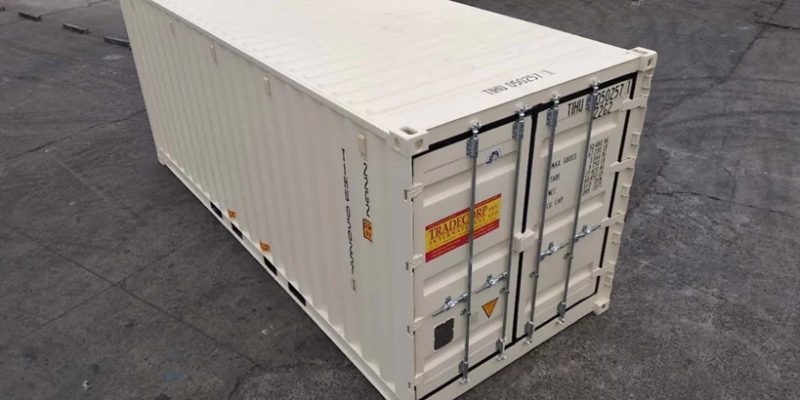
Ask for a shipping container without specifying anything and this is what turns up. A GP container general purpose, also called a dry van is the closed steel box with doors at one end that makes up the large majority of the world fleet. Knowing what it does well is less useful than knowing the three or four situations where it is the wrong tool, because that is where money gets wasted and schedules break.
What the Two Letters Mean
GP stands for general purpose, and the classification is defined as much by what the unit lacks as by what it has. There is no refrigeration machinery, no removable roof, no side access and no tank. What there is: a weatherproof steel shell, a plywood or bamboo floor laid over steel cross members, corrugated side walls that give the structure its rigidity, corner castings for lifting, and a pair of doors at one end fitted with rubber gaskets and locking rods. Cargo goes in through those doors and comes out the same way.
The Numbers That Matter
A 20-foot measures 6.058 m by 2.438 m by 2.591 m externally, holds around 33 cubic metres and carries a payload near 28 tonnes once tare is deducted from a 30,480 kg maximum gross. The 40- foot doubles length to 12.192 m for roughly 67 cubic metres, but maximum gross does not double, so payload falls closer to 26 tonnes. That asymmetry is the single most useful fact about the format: the shorter unit carries more weight, the longer unit carries more volume, and choosing between them is a density question.
What It Carries Well
Palletised goods, cartons, bagged commodities, drummed liquids, machinery on skids, furniture, building materials, vehicle parts, packaged food with no temperature requirement anything that stacks, secures and survives several weeks unattended. Two standard pallets sit side by side across the internal width with a little clearance, so eleven fit a 20-foot floor and around twenty-four fit a 40-foot in a single layer. Cargo matching that profile is precisely why the format dominates the global fleet.
What It Handles Badly
Temperature-sensitive goods need a reefer, since the interior of a sealed steel unit in tropical sun runs far hotter than ambient air. Cargo taller than internal height, or that must be lowered in from above, needs an open top. Long items that cannot turn through the door aperture need a flat rack. Bulk liquids need a tank. And anything carrying residual moisture into a sealed box crossing climate zones needs desiccant and liner protection, because condensation will otherwise rain onto the load from the roof.
Standard Height or High Cube
The high cube shares the footprint but adds roughly 300 mm of internal height, giving about 76 cubic metres in the 40-foot length. For light, bulky freight the small rate premium is usually worth paying. For dense cargo it is not, because the weight ceiling arrives long before the extra height gets used. Both are handled identically as intermodal container units across ship, rail and road, so the decision rests purely on cargo profile. Check road and gateway height limits at the delivery end before ordering high cube.
Loading and Weight Distribution
An evenly distributed load is not optional. Concentrating heavy items over a short run of floor can exceed the cross-member rating even when total weight sits legally within limits, and an off-centre load creates handling problems for cranes and stability problems on a chassis. Block and brace so cargo cannot shift, because a load that moves in a seaway damages itself and can push the doors out of alignment badly enough that they will not close. Fill voids with dunnage bags rather than trusting friction.
Life on Land
Away from freight, the same unit is the default for secure site storage, tool and equipment stores, document archives and workshop space. It locks, it resists weather, it relocates on a tilt-bed truck and it holds resale value. The usual modifications personnel doors, vents, windows, insulation, electrical fit-out are all routine work on this format precisely because it is the most common one, which keeps conversion quotes sensible and lead times short.
Inspect Before You Load, Not After
Ten minutes with the doors open saves a claim later. Stand inside with the doors shut and look for daylight along the roof seams and door gaskets, which is the fastest pinhole test there is. Run a hand along the floor for soft patches and check the cross members underneath for corrosion, because a floor failure under a forklift is expensive and dangerous. Sniff for chemical residue or mould, since a previous cargo can taint a new one and food or textile loads are unforgiving about it. Confirm the lashing points along the top rails and floor are intact, because they are what your bracing will attach to. Photograph everything before stuffing begins.
When It Is the Right Call
Choose it when the cargo is general dry freight, when the volume-to-weight ratio is unremarkable, and when nothing about shape or temperature forces a specialised format. Choose against it the moment any of those conditions fails, because forcing awkward cargo into the standard box costs more in wasted space and damage than the right equipment would have. For everything in between, which is most freight, a GP container is cheapest to source, easiest to replace mid-schedule and simplest to sell on afterwards.









Comments